
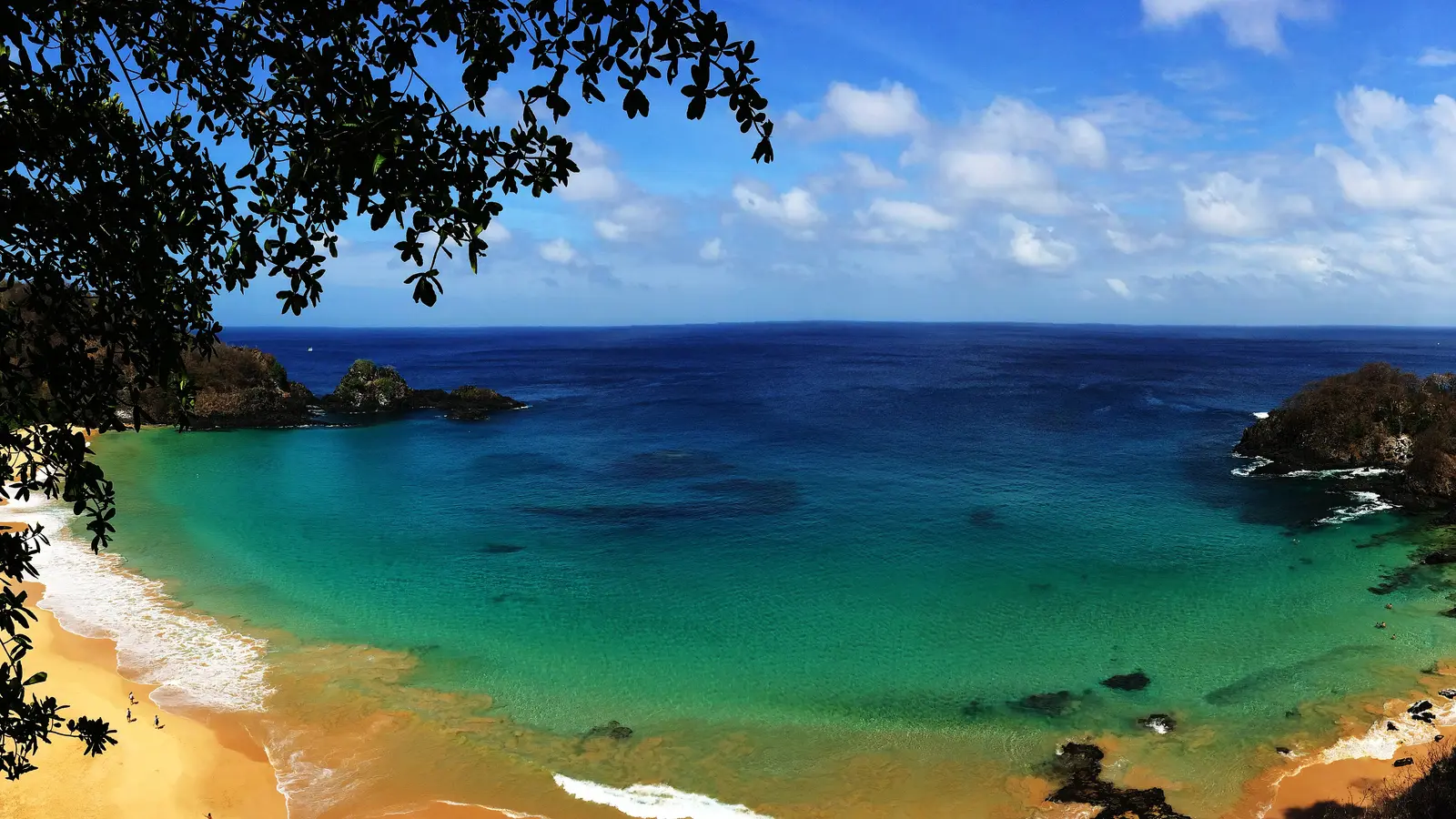

There is a moment on the flight out to Fernando de Noronha, somewhere past the halfway mark, when the mainland has been gone for twenty minutes and there is nothing under the wing but open Atlantic. It is the first honest signal that this is not simply another Brazilian beach. It is a volcanic outpost 350 kilometres from anywhere, and it has rules.
Quick answer: Fernando de Noronha is an archipelago of 21 islands off the coast of Pernambuco, of which one is inhabited. About seventy percent of it is a national marine park, the whole property has been UNESCO World Heritage since 2001, and visitor numbers are capped. You can only fly in, from Recife or Natal, in about an hour. Two separate fees apply, a daily environmental tax and a ten day park ticket. Four to six days is the right length, August to November is the best window, and the beaches, Baía do Sancho above all, are the best in Brazil by a margin that is not really arguable.
What is Fernando de Noronha, and why is it different?
Geologically it is the top of an extinct volcano that stopped just short of making a proper island chain. Practically it is one inhabited island of about 17 square kilometres, a single road running its length, roughly three thousand residents, and a limit on how many visitors may be there at once.
That limit is the whole story. Most beautiful places get discovered, then loved to death, then managed badly afterwards. Noronha was made a national marine park in 1988 and a UNESCO World Heritage site in 2001, together with the Atol das Rocas, and the protection came early enough to work. The reef is alive. The water at Sancho is the colour it is in the photographs, which is not something we say about many photographed beaches.
What you trade for that is convenience. There is no bridge, no ferry worth the name, no chain hotel, no big supermarket, and no possibility of deciding on Tuesday that you fancy going on Thursday.
Getting there, and why the flight is the hard part
Two airports serve the island: Recife, a little over an hour, and Natal, roughly an hour. Azul and Gol fly the route. That is the entire list of options.
The aircraft are small and the schedule is thin, which means seats sell out months ahead and cost a great deal more than the distance suggests they should. Around New Year, Carnival and the July school holidays they can be gone half a year in advance. This is the single most common reason a Noronha plan collapses, and it collapses at the flight, never at the hotel.
The practical consequence for planning is that the island goes into the itinerary first and everything else arranges itself around it. We also build in a night in Recife or Natal on each side rather than connecting tight, because a missed connection here does not mean a later flight, it means a different day.
The two fees nobody explains before you book
Two different authorities, two different tickets, and almost every first-time visitor is surprised by at least one of them.
The environmental preservation tax, the TPA, goes to the island administration and is charged per day of your stay. In 2026 it is R$ 105.79 for the first day, and it is progressive, so it climbs the longer you remain. Seven days comes to roughly R$ 670. It is payable online before you travel, and if your credit card was issued outside Brazil you may have to settle it at the airport desk on arrival, which is worth knowing before you join the wrong queue.
The national park ticket is separate, goes to the park itself, and costs R$ 384 for foreign visitors, half that for Brazilians, valid for ten consecutive days. You need it for Baía do Sancho, Baía dos Porcos, Praia do Leão, Sueste and the park trails, which is to say for most of the reason you came.
Neither fee is optional and neither is a scam. Between them they are why the place still looks like this.
What does a trip to Fernando de Noronha cost?
Privately guided, our stays here start at about US$1,350 per person for five days.
Where you land above that comes down to two things: which pousada, and how much of the island you want guided rather than driven yourself in a buggy. That figure covers the time on the ground, the accommodation, the transfers and the guiding. It does not cover flights, which we do not sell.
On top sits the island's own bill, which is not optional and is what catches people at the arrivals desk. The national park ticket is R$ 384 for foreign visitors, valid ten consecutive days. The environmental tax is charged for every day you stay, R$ 105.79 for the first day in 2026 and rising the longer you remain, so a full week comes to R$ 672.85.
Noronha is the most expensive place per day that we send anyone in Brazil, and we would rather say so plainly. The flight is limited and priced accordingly, everything on the island arrives by air or sea, and the two conservation fees are real money doing real work. It is also the one destination where a shorter, better stay beats a longer, thinner one.
The beaches, in the order that matters
Baía do Sancho is the one.
You reach it by walking to the clifftop, then down a metal ladder wedged into a crack in the rock, then a staircase, and then you are on a crescent of sand at the foot of a green wall with the sea in three distinct blues. It has been voted the best beach in the world so often that the ranking has stopped being interesting; go early, before the day boats.
Baía dos Porcos, next door, is small, rocky and photographs better than it swims, sitting directly under Morro Dois Irmãos, the twin rock that ends up on every single photo anyone brings home from this island.
Cacimba do Padre is the long one on the north coast, with Dois Irmãos at the end of it, calm in the second half of the year and home to a serious surf break from about January to March.
Praia do Leão on the south side is wilder, emptier, and where green turtles come ashore to nest between roughly January and June.
Baía do Sueste is the snorkelling beach, shallow and turtle-heavy, with mandatory vest and no fins.
And Atalaia, on the wild eastern shore, is a tidal pool rather than a beach, entered on a booked and timed slot with a guide, in a group small enough to count, in the window when the tide has fallen. Mask and snorkel only, no fins, no sunscreen. It is the most rule-bound thing you will do on the island and one of the best.
Diving, dolphins and the water
Noronha is the best diving in Brazil and it is not a close contest.
Warm water, visibility that regularly runs past thirty metres, lemon and nurse sharks, green turtles, rays, and dive sites that see a fraction of the traffic a Caribbean reef does. Certified divers get two tanks on the outer sites; if you have never breathed underwater, a supervised first dive here is a considerable way to start.
Then there are the dolphins. Several hundred spinner dolphins come into the Baía dos Golfinhos at first light to rest after a night of hunting offshore. You watch them from the clifftop viewpoint rather than from the water, because the bay is closed to boats and swimmers, which is precisely why they keep coming. It requires an alarm before sunrise and it is worth every minute of the lost sleep.
Snorkelling off the beaches is excellent in the calm months and frustrating in the swell, which brings us to timing.
When to go
August to November is the window. The rain has stopped, the sea on the north coast is at its calmest, and underwater visibility is at its best. If you are coming for the water rather than the waves, come now.
January to March is wetter, and a heavy swell arrives on the north coast. That is poor for snorkelling and very good indeed for surfing, because Cacimba do Padre in season is one of Brazil's genuine waves. Turtle nesting runs roughly January to June.
April to July is the shoulder, greener, quieter and often excellent value by island standards, with more chance of a grey afternoon.
The island works all year. What changes is which half of it works. Our guide to the best time to visit Brazil puts this in the context of a wider route.
How many days, and where it fits
Four full days is the honest minimum. Five or six is better, because the tide table and the swell decide the order of your days here, not your plan, and you want the slack to reshuffle when Atalaia's window lands at seven in the morning on the day you wanted to dive.
It fits naturally after Recife and Olinda, alongside the beaches of Bahia further south, or as the quiet half of a route whose other half is the Amazon or Rio. It does not fit a tight schedule and it does not reward a two night stopover. Our two week Brazil itinerary shows how a route breathes around a stop like this one.
If you want the whole picture of what a stay here involves, from the fees to the pousadas to the park slots, the Fernando de Noronha destination page sets out how we plan it.
Summary FAQ
How do you get to Fernando de Noronha? By air only, from Recife (a little over an hour) or Natal (about an hour), on Azul or Gol. Seats are limited and sell out months ahead, so the flight goes into the plan before anything else does.
How much are the Fernando de Noronha fees? Two of them. The environmental tax is R$ 105.79 per day in 2026 and rises the longer you stay, so a week is roughly R$ 670. The national park ticket is R$ 384 for foreign visitors and is valid for ten consecutive days.
Is Baía do Sancho really the best beach in the world? It has topped the global ranking more often than any other beach in Brazil, and unlike most such winners it survives the walk down the cliff ladder with its reputation intact. Go early in the day and judge for yourself.
What is the best time to visit Fernando de Noronha? August to November, for calm seas and the best underwater visibility. January to March is wetter with a big north swell, which suits surfers and frustrates snorkellers. Turtles nest roughly January to June.
How many days do you need on Fernando de Noronha? Four full days minimum, five or six ideally. The tides and the swell set the running order, so a stay with no slack in it will lose you the one thing you most wanted to do.
Is Fernando de Noronha expensive? Yes, by Brazilian standards, and honestly so. Flights are limited, everything on the island arrives by air or sea, and the two conservation fees are real money. It is the one place in Brazil where we tell people plainly that a shorter, better stay beats a longer, thinner one.
How much does Fernando de Noronha cost? Privately guided, from about US$1,350 per person for five days on the ground, accommodation, transfers and guiding included, flights excluded. The island then charges separately: R$ 384 for the national park ticket, valid ten days, plus a daily environmental tax that starts at R$ 105.79 and rises with the length of your stay.
Tell us your dates and how the rest of your route looks, and we will start with the flight, because that is what decides whether the rest is possible. You will have a personal, non-binding proposal within 24 hours. Noronha also sits in our honeymoon and milestone journey, which is where most of our island stays end up.
Official sources
The rules and figures in this article come from the official bodies below. They change, so check them for your own dates.
- Brazilian Atlantic Islands: Fernando de Noronha and Atol das Rocas Reserves, World Heritage List · UNESCO
- Parque Nacional Marinho de Fernando de Noronha, tickets and visiting rules · ICMBio / Parna Noronha
- Taxa de Preservação Ambiental, the island’s daily environmental tax · Distrito Estadual de Fernando de Noronha
- Fernando de Noronha
- Pernambuco
- Beaches
- Diving
Turn it into your own Brazil trip
Tell Robin your dates and what caught your eye, or pick the destinations and experiences you love and send us your own route to plan.
Non-binding, a personal reply within 24 hours, in English or German.