
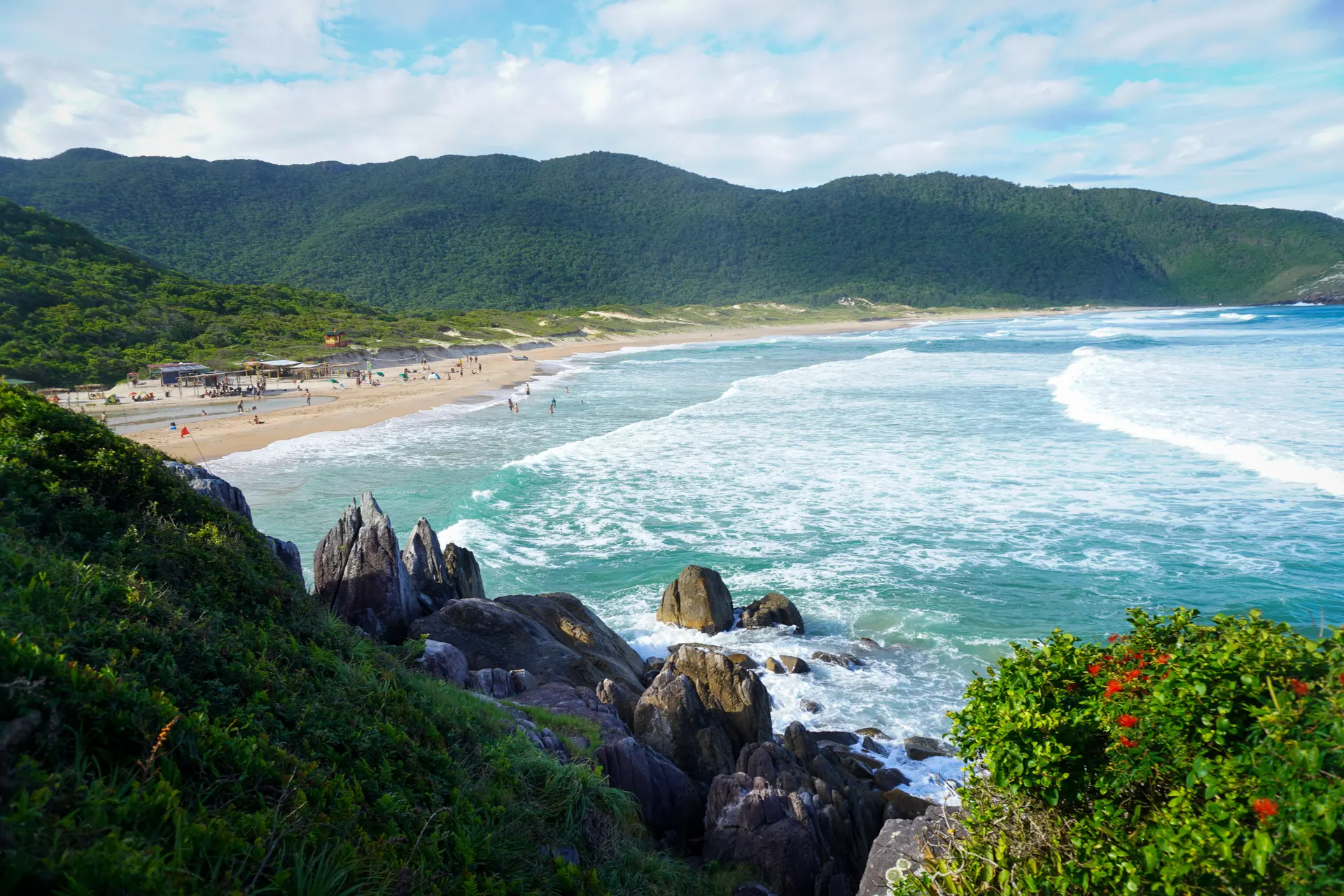

We live on Florianópolis, which means we get asked one question more than any other, usually by text, usually from a friend of a friend: which beach? It is a reasonable question and a slightly unfair one, because the island has 42 of them and they are not variations on a theme.
Quick answer: Florianópolis has 42 beaches on one island, and the choice depends on what you want from the day. Walk to Lagoinha do Leste for the best one, boat out to Ilha do Campeche when the sea is flat, go to Joaquina for surf and dunes, and to Canasvieiras in the north with children. Swim from November to April.
How many beaches does Florianópolis have?
Forty-two, on a single island barely 50 kilometres long that you can drive end to end in about ninety minutes.
The simplest way to read them is as two islands joined in the middle. The south stays undeveloped on purpose: dirt access roads, Atlantic forest down to the sand, a strong surf culture and beaches you reach on foot. The north is the sociable side, with warmer, flatter water, family beaches and the beach clubs.
Which half you are in tells you almost everything about the day, so the list below is sorted by what you want rather than by the map.
If you want to earn it: Lagoinha do Leste
If you do one thing on the island, make it this.
Lagoinha do Leste is one of the most photographed beaches in Brazil, and it stays that way because there is no road to it. The trail climbs through Atlantic forest and over a ridge, then drops you onto a wide crescent of sand with a lagoon behind it and, usually, almost nobody on it.
There are two ways in. The main trail from Pântano do Sul is longer and more gradual. The route over Morro da Coroa is steeper and shorter, with the bigger view from the top. Either way, bring water and go in the morning.
If the sea is flat: Ilha do Campeche
This is the one that surprises people, because it is not on Florianópolis at all.
You take a small boat across a short stretch of open water and land on a separate island with water clear enough to see your feet in the shallows. Campeche is a protected conservation and archaeological site with capped visitor numbers, which is exactly why it still feels untouched. Half beach day, half small expedition.
If you surf, or like watching people who do: Joaquina
Joaquina is where the island's surf identity is loudest, a competition beach for decades.
Even if you never touch a board, come for the dunes: a big field of pale sand behind the beach that people sandboard down, and that turns gold in the late afternoon. It is the rare place where serious surf and what looks like a small desert sit side by side. Our surfing guide covers the island from a surfer's point of view, including Praia Mole and Santinho.
If you want space: Mocambique
The longest beach on the island, a straight run of open sand backed by protected forest with almost nothing built on it.
It is where you go for quiet rather than facilities. The best way to take it in is on horseback, along the edge of the water, which is a genuinely local thing to do here and considerably better than it sounds.
If you are travelling with children: the north
Canasvieiras is the classic family beach, with calm, warm water and an unfussy holiday feel.
Jurerê Internacional is the polished version of the north: wide manicured streets, high-end holiday homes and beach clubs with a see-and-be-seen summer crowd. Praia do Santinho, for a gentler north, pairs a good beach with its own field of dunes. The north is also the base most first-time visitors choose, and for a family it is usually the right one.
The coast that is not about the beach
The south-west shore is the island's oldest and most Portuguese corner, settled by families from the Azores in the 1700s.
Ribeirão da Ilha is its heart: a colourful fishing village on a calm channel and the centre of Brazil's oyster farming. You eat them a few metres from where they came out of the water. A little further up, Santo Antônio de Lisboa has whitewashed colonial houses and the sunset over the water. Neither is a swimming beach. Both are worth an evening.
When is the water warm enough to swim?
From November, sometimes late November, through April. That whole stretch is beach weather.
December to March is the Brazilian summer, with the warmest water and the liveliest scene, and also the busiest, especially in the north and especially in January. The two ends are the ones we pick for ourselves. November is warm and still quiet. April is our favourite month on the island: the sea has the whole summer stored in it, the light turns golden and the crowds have gone home.
June to August is cool and green and very good for the trails, and you will not want to swim much.
Getting between the beaches, and how long to stay
You want a car or a private driver, because the best beaches run from the far south to the far north and public transport between them is slow.
Within one walkable district such as Lagoa da Conceição or Jurerê you can manage without for a few days, and ride apps work in the developed areas. Three nights give you a first taste. Five to seven is where the island makes sense: a hike-in beach, a Campeche day, an oyster afternoon and both halves without spending every morning in the car. Florianópolis is about an hour's flight from São Paulo.
Summary FAQ
What is the best beach in Florianópolis? Lagoinha do Leste, for most people. It has no road, so you reach it on a forest trail over a ridge, and it rewards the walk with a wide, usually empty crescent of sand and a lagoon behind it. Go in the morning and bring water.
How many beaches are there in Florianópolis? Forty-two, on a single island of barely 50 kilometres. The wilder, surf-first beaches are in the south and the calmer, more developed family beaches in the north.
Which Florianópolis beach is best for families? Canasvieiras in the north, with calm, warm water and an easy holiday feel. Jurerê Internacional is the upscale alternative, and Praia do Santinho is the quieter one with its own dunes.
When can you swim in Florianópolis? November to April. December to March is warmest and busiest, with January the peak. November and April are warm and much quieter, and April is our favourite month. June to August is for hiking rather than swimming.
Do you need a car in Florianópolis? For seeing more than one district, yes, or a private driver. The best beaches are spread from the far south to the far north and public transport between them is slow.
How many days do you need in Florianópolis? Five to seven. Three nights give you a taste, but with less than five you end up choosing between the wild south and the social north instead of seeing both.
Florianópolis is our home island, and it is the surf and trail leg of our adventure journey. If you would rather build a week here around your own pace, the Florianópolis page shows how we plan it. Tell us your dates and you will have a personal, non-binding proposal within 24 hours.
Official sources
The rules and figures in this article come from the official bodies below. They change, so check them for your own dates.
- Visit Brasil: Florianópolis · Embratur, Governo Federal do Brasil
- INMET, the national meteorological institute · Governo Federal do Brasil
- Brazilian Ministry of Tourism · Governo Federal do Brasil
- Beaches
- Florianópolis
Turn it into your own Brazil trip
Tell Robin your dates and what caught your eye, or pick the destinations and experiences you love and send us your own route to plan.
Non-binding, a personal reply within 24 hours, in English or German.