
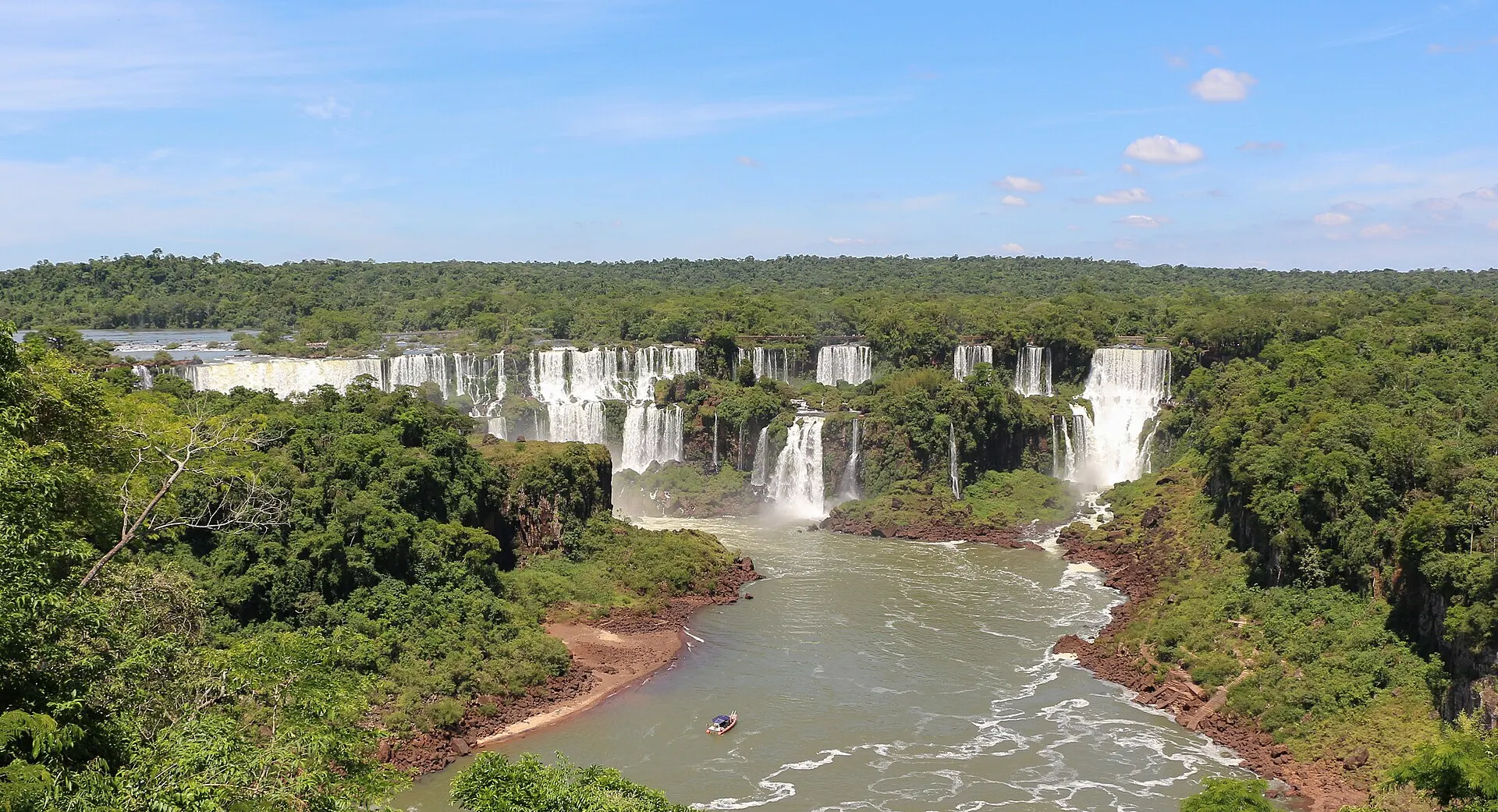

Ask our guests what surprised them most at Iguazu and the answer is rarely the height. It is the width. The falls are not one drop but roughly 275, strung in a horseshoe across nearly three kilometres of rainforest on the border of Brazil and Argentina, taller and far wider than Niagara, set not in a city but in a national park alive with coatis, toucans and butterflies. The Guaraní named the river 'big water', and as understatements go it has aged remarkably well.
Quick answer: Plan three to four days in Foz do Iguaçu and see both sides of the falls. The Brazilian side delivers the panorama in half a day; the Argentine side is the larger park and a full day of catwalks that end at the lip of the Devil's Throat. Walk them before the park opens to the public or in the last hour before it closes and they are a different national park altogether. Fly into Foz do Iguaçu, a quick internal flight from almost anywhere in Brazil, then add the boat ride under the cascades, the helicopter above them, the bird sanctuary by the park gates, and a third and fourth day of forest trails, quiet waterfalls and a border crossing into Paraguay.
Which side of Iguazu Falls is better, the Brazilian or the Argentine?
Both, and they do different jobs, so the real answer is to stop choosing. The Brazilian side is the panorama: a cliff-edge trail that delivers the whole sweep of the falls in one frame, ending on a catwalk that juts into the spray below the Devil's Throat.
Three to four hours covers it well. The Argentine side is the larger park and the close-up, a full day on catwalks that lead right to the edge of the Garganta del Diablo, the 80 metre throat where half the river vanishes at your feet.
The two countries have been quietly disagreeing about which side is better for about as long as there has been a border there. See both and you are allowed to abstain.
Timing is the part a private plan actually changes. We walk the Brazilian panorama trail in the late afternoon, when the light softens and the tour buses thin out, and save the Argentine catwalks for a full day of their own. On the catwalks, the standing advice is to bring a poncho. Do bring one, and know that the Devil's Throat regards it as a formality.
What is the best time of day to visit Iguazu Falls?
First light or last light, and the difference is not subtle.
The coaches reach the walkways from about half past nine, and the middle of the day belongs to them: the same viewpoints, three deep at the railing, hard overhead light that flattens everything. From around four in the afternoon those same buses drain away again.
That leaves two windows either side of the crowds, and they are a different national park altogether. Before general opening a small number of visitors are let in, and for the first hour the falls belong to them, mist still hanging in the gorge, coatis and toucans still moving. It runs about three hours, the alarm is early and the places are few, which is why we lock it in as soon as your dates are set. Late entry does the same trick from the other end of the day and is the easier of the two: the sun drops behind the Argentine bank, the gorge turns amber, and rainbows stand in the spray. It is the finest sunset in the region, and the reason we so often put the Brazilian side at the end of a day rather than the start.
Neither window is simply for sale. Our guides do charitable work inside the national park, and it is that standing which opens the gates for our travellers before the park receives the public and again once it has closed. To have one of the most extraordinary places on earth almost entirely to yourself is a rare thing anywhere. Here it is the difference between seeing the falls and having them.
What is there to do at Iguazu besides looking at the falls?
More than one trip usually has room for, which is an argument for the third day.
- The Macuco Safari boat. An inflatable powers up the rapids and straight under the cascades until you are soaked through and laughing. About two hours, and the closest you can get to the falls without being river.
- The helicopter. Ten or thirty five minutes over the Brazilian park. Only from the air does the full horseshoe reveal itself, the Devil's Throat smoking white below and the rainforest running unbroken to the horizon.
- Parque das Aves. Right by the park gates, a sanctuary you walk through from the inside: rescued toucans, scarlet ibis and harpy eagles in walk-in aviaries, a flamingo lagoon and a butterfly house, with free-flying macaws overhead. Two to three hours, and the one stop our guests most often say they nearly skipped and are gladdest they did not.
- Marco das Três Fronteiras. The confluence of the Iguaçu and Paraná rivers, where Brazil, Argentina and Paraguay face each other across the water, three obelisks, three flags, and a sound and light show after dark. It is the easiest way we know to look at three countries before dinner without repacking a single bag.
- The Itaipu dam. A tour of the giant hydroelectric works upriver, best caught for the after-dark lighting show, and an easy add-on for travellers who like their engineering on the same scale as their waterfalls.
- A day across into Paraguay. Almost nobody plans for it, and it is the easiest day the region gives you: the Saltos del Monday, a broad three-part waterfall dropping into a green gorge with a rainbow in the spray and, most mornings, nobody in it; the biological refuge on the Paraguayan flank of Itaipu, where rescued jaguars, tapirs and giant anteaters live in the forest the dam displaced; and the border theatre of Ciudad del Este. Lunch in a third country, back at your hotel in Brazil by dinner. Passports go in the day bag.
What fills a third and a fourth day in Foz do Iguaçu?
The national park is around 185,000 hectares of Atlantic rainforest, and the famous walkways touch a sliver of it. Step off them and the region opens up, which is the whole argument for staying past the second night.
- The park road on a bicycle. Thirteen kilometres of closed rainforest run between the visitor centre and the start of the walking trails. On two wheels it stops being transit and becomes the point: you hear the forest instead of a coach engine, stop wherever the guide sees something, and arrive already inside the park rather than tipped out at a car park. About three and a half hours with a certified guide.
- The São João forest trail. Five kilometres from the visitor centre straight into the Atlantic forest, and the fastest way to understand that Iguaçu is a rainforest with a waterfall in it rather than the other way round. Butterflies, birdsong, capuchin monkeys overhead, light coming down in shafts, and the roar somewhere behind you. Half a morning.
- Waterfalls you can swim in. Within a couple of hours of Foz sit small trails that each end at a waterfall with a pool under it. Perobas near Céu Azul is six kilometres through a different forest formation. Apepu, close to São Miguel do Iguaçu, runs seven kilometres along a bluff above the river and is led by guides from the community that lives there. Saltão near Capanema starts with a boat across the river. Nobody queues at any of them.
- Kayaking above the falls. Upstream of everything the Iguaçu River goes wide and slow, and a kayak is the quietest seat in the region. A half day pairs the paddle with a short forest walk and a swim under a waterfall. No experience needed and no rapids involved, just water, forest and herons lifting off ahead of the bow.
- A food walk through the border city. Foz was built by people from everywhere and it eats accordingly: Lebanese pastries next to a Paraguayan chipa counter next to a churrasco grill, all within a few blocks of the centre. Around three hours on foot from about half past four, with someone who knows which door to open.
- A Guarani community across the river. The Guarani were here long before the border was, and the name Iguaçu is theirs: y guasu, big water. On the Argentine side a community receives visitors with its own guides, walking you through the forest they use, the craft they make from it and a reading of this landscape that predates every park gate on it. An hour or two, and it changes how the falls read for the rest of the trip.
None of this replaces the falls. It is what turns them into the beginning of a trip instead of the whole of it.
How do you get to Iguazu Falls?
You fly to Foz do Iguaçu, which has its own airport and sits a quick internal flight from almost anywhere in Brazil.
That is why the falls slot so neatly into a longer route rather than demanding one of their own. On our trips we meet you at the airport, and every transfer runs privately, including the border crossing.
The Argentine side is another country, so your passport comes along for the day and your guide handles the formalities at the border, along with the tickets and the timing that keeps you ahead of the crowds. For entry into Brazil itself, US, Canadian and Australian passport holders have needed an e-Visa since 10 April 2025. It costs US$80.90 and is applied for online before you fly, not at the airport.
As for when to come, the falls run all year. The water is highest and most thunderous from December to February after the summer rains, and May to August brings milder air and clearer skies for photographs. Foz sits at the cool end of Brazil, so in the southern winter months pack a real jacket alongside the poncho.
How many days do you need in Foz do Iguaçu?
Three to four days, with two full days as the honest minimum.
One day for the Brazilian side, one for the Argentine side, a third for the extras, the boat, the helicopter, the birds, the three-border point, and a fourth that buys you the forest trails, the quieter waterfalls and a day across into Paraguay.
Two days works if you hold the extras to one; a single day means choosing a side after all, which is exactly the choice worth avoiding. Almost every regret we hear about Iguaçu comes down to the same thing: people flew in for one day, saw one side, and left sensing they had missed something, because they had.
We shape the order around the weather and around you. A fast pair of travellers can fold the Brazilian side and the bird park into one day; a slower pace spreads the same ground over three easy mornings, and there is no wrong answer between them, only your answer.
Is Foz do Iguaçu safe?
The national parks and the main visitor areas are well organised and easy, on both sides of the border.
Foz itself is a border town, so a little local know-how helps, and that is precisely what a private guide provides: they are with you through the day, they know which advice matters, and following their simple, sensible tips covers most of the rest, including your own free time in the evenings. We will not tell you any place is simply safe, because that sentence is never quite true anywhere. We will tell you what the guide removes, which here is most of it, and we remain a message away for the rest.
If your alternative is a big brand tour, here is the honest comparison. The brand gives you a call centre in your time zone and a polished catalogue, and those have real value. What it cannot give you is the person who actually runs your days at the falls, reachable directly, which is the thing that matters at a border crossing far more than a catalogue does.
What does it cost, and what will go wrong?
We only plan private, tailor-made trips: your own English-speaking guide for both parks, every transfer including the border crossing, park tickets pre-arranged and hand-picked hotels, from a boutique town hotel to a place on the edge of the jungle inside the Brazilian park.
The price depends on your dates, your hotel category and the extras, so we would rather build your own number than print an average that fits nobody: non-binding, within 24 hours. As an anchor while you plan, three days in Foz do Iguaçu start at US$800 per person in our two week Brazil itinerary, privately guided with accommodation and transfers included. We are not the cheapest way to see the falls, and we will say so plainly: a pooled bus from town beats us on price every time. What we sell is the version with nobody else's schedule in it.
And what will go wrong, because every honest page needs this paragraph: the weather owns the schedule here. A grey morning can ground the helicopter or dull the panorama, which is why we keep the order of your days flexible and swap them when the sky says to. You will also get wet, at the boat by design and at the catwalks by decree. Neither has ever counted as a complaint afterwards.
What does Iguazu combine with?
Almost anything, which is its quiet superpower. The classic southern loop pairs the falls with Rio de Janeiro and the island beaches of Florianópolis; wildlife travellers carry on to the Pantanal instead.
Our Foz do Iguaçu destination page shows how a private visit there is built day by day, and if you are placing the falls inside a longer route, our three week Brazil itinerary shows where they usually land. For the route it belongs to, see our sixteen-day highlights journey.
Summary FAQ
Which side of Iguazu Falls is better, Brazil or Argentina? Both are worth it and they do different jobs. The Brazilian side gives the full panorama in three to four hours; the Argentine side is the larger park, a full day of catwalks ending at the lip of the Devil's Throat. Plan to see both.
How many days do you need at Iguazu? Three to four, with two full days as the minimum. One per side of the falls, a third for the extras, the Macuco boat, the helicopter, the Parque das Aves and the three-border point, and a fourth for the forest trails, the quieter waterfalls and Paraguay.
What is the best time of day to visit Iguazu Falls? Before the park opens to the public, or in the last hour before it closes. The coaches fill the walkways from about half past nine and leave again around four, so those two windows are nearly empty and carry the best light of the day. The charitable work our guides do inside the national park is what makes entry in both of them possible for our travellers.
How do you get to Iguazu Falls? Fly to Foz do Iguaçu, which has its own airport and is a quick internal flight from almost anywhere in Brazil. The Argentine side is reached by a road crossing of the border, which on a private trip is handled for you.
Do US citizens need a visa for Brazil? Yes. US, Canadian and Australian passport holders have needed an e-Visa since 10 April 2025. It costs US$80.90 and is applied for online before travel.
Is Foz do Iguaçu safe for tourists? The parks and main visitor areas are well organised and easy. Foz is a border town, so local know-how helps, which is what a private guide provides through the day and by advice for your evenings.
What else is there to do in Foz do Iguaçu? The Macuco Safari boat under the cascades, a helicopter flight over the horseshoe, the Parque das Aves bird sanctuary, the Marco das Três Fronteiras where three countries meet, and tours of the Itaipu dam. A third and fourth day add the 13 km park road by bicycle, the São João forest trail, waterfalls with swimming pools under them at Perobas, Apepu and Saltão, kayaking above the falls, a food walk through the border city, and a Guarani community visit on the Argentine side.
If two days of falling water and a third of macaws sound like your kind of trip, tell us your dates and interests and you will have a personal, non-binding proposal within 24 hours. If you are still deciding where Iguazu fits in the larger route, tell us that instead. Placing it is one of the easiest jobs we have.
Official sources
The rules and figures in this article come from the official bodies below. They change, so check them for your own dates.
- ICMBio, the federal agency for Brazil’s national parks · Governo Federal do Brasil
- INMET, the national meteorological institute · Governo Federal do Brasil
- Official Brazil e-Visa portal · Government of Brazil / VFS Global
- Foz do Iguaçu
- Iguazu Falls
- Destination guide
Turn it into your own Brazil trip
Tell Robin your dates and what caught your eye, or pick the destinations and experiences you love and send us your own route to plan.
Non-binding, a personal reply within 24 hours, in English or German.