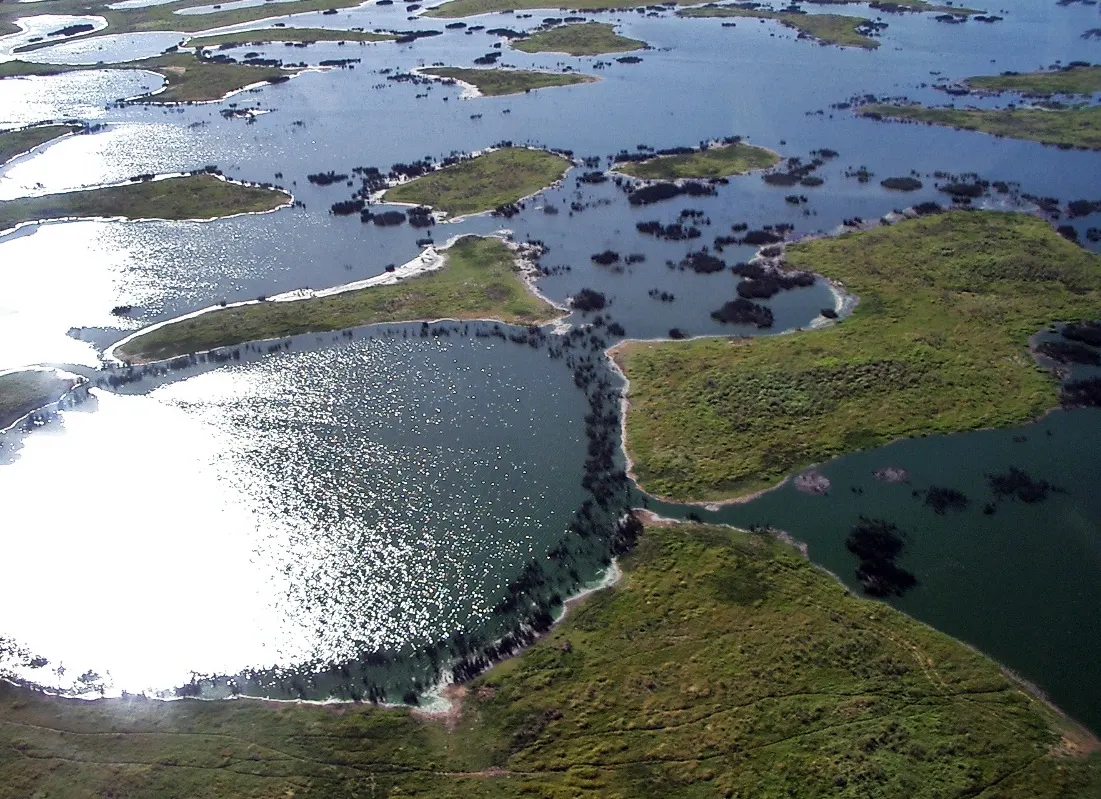
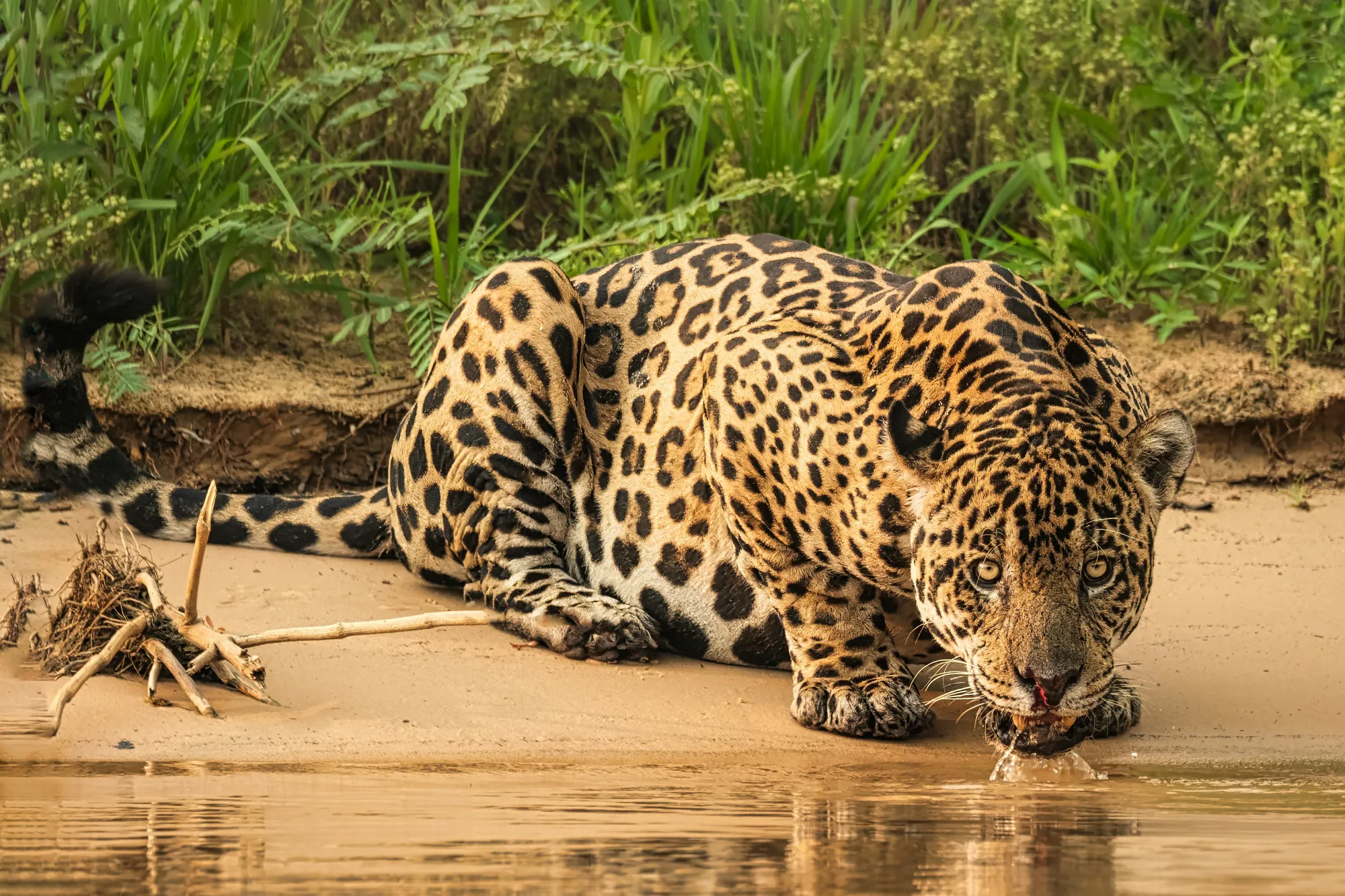

The word our guests use for this trip is safari, which is not the word we would have picked for a wetland. They are right and we were not. You get into a small boat before the light is up, and you go looking for a cat.
Quick answer: A Pantanal jaguar safari is jaguar watching from the water. You work the rivers and quiet side channels of the largest tropical wetland on Earth by boat, in the dry season, roughly June to October, and the strongest stretch is July to September (the absolute High-Season with very low availability). Trips run 3 to 8 days, five is the length we recommend most often, and there are three ways in: Porto Jofre and the Transpantaneira in the north, the roadless country west of Cáceres, and Campo Grande in the south. Everything we plan here is private, so there is no departure to wait for and no minimum number of travellers. And nobody honest will promise you a sighting.
What does a day actually look like?
It starts in the dark. The animals move at the edges of the day, so you are on the water at first light with a naturalist guide and a boatman who has been reading these banks for years, and you come back in when the heat flattens everything out. Late afternoon you go again.
The cat is the reason you came. It is not the only thing you will see, which is worth knowing before you spend five days looking. Capybaras everywhere. Caimans by the hundred along the banks. Giant otters, loud and completely unbothered. Hyacinth macaws overhead, and the jabiru storks that are the emblem of the place. On the long safari days lunch travels with you.
After dark a spotlight goes along the banks and finds what the day hides, caiman eyes, a tapir, night monkeys, now and then a jaguar on the move.
Not all of it happens on the water. Away from the rivers you cross the plains of the working cattle ranches, the fazendas, by 4x4 and on horseback where the ranch allows it, with the Pantaneiros who still make their living out there.
Here is the part only a private trip can give you. At seven in the morning the sensible thing is often to stay at one riverbank for another hour rather than move on, and on your own boat that call is yours. On a shared departure it belongs to somebody else's lunch.
Where is the good jaguar country?
Three doors, and they are genuinely three different trips.
- The north, through Cuiabá. The famous one. From Cuiabá the Transpantaneira runs south, a raised dirt road over hundreds of little wooden bridges, and it ends at Porto Jofre and the Encontro das Águas, where jaguars live at one of the highest densities anywhere. Almost everyone who comes to see a jaguar comes here, which is both the argument for it and the argument against it. Our private jaguar safari in the northern Pantanal runs on this road.
- The west, past Cáceres. Beyond Cáceres the roads run out. What is left is water, the strictly protected Taiamã reserve, and the mountains of the Serra do Amolar, a corner of the wetland that tourism has barely touched and that even experienced Pantanal travellers rarely reach. Our six-day western Pantanal safari is built around boats for exactly that reason, and the eight-day expedition cruise runs the whole western wetland from Cáceres to Porto Jofre, with your own safari boat working off a small expedition ship.
- The south, through Campo Grande. The other main entrance to the Pantanal, and a different feel again.
The water is the same in all three, so the calendar is the same in all three. What changes is what you do all day. In the north you drive and then you launch. In the west you never really leave the water.
When should you come?
June to October is the dry season, and that is not a preference, it is the mechanism. From December to March the wetland floods, the animals have water in every direction and they spread out across a plain the size of a country.
From May the water drains back into the rivers and channels. By July there is not much left, and a jaguar has fewer places to drink.
July to September is the strongest stretch. If you gave us a free hand we would send you in August, because July is the Brazilian school holiday month and a nationwide domestic travel peak, so lodges are fuller. From late September the fire season can put haze in the air, which matters more if you came to photograph than if you came to look. October is hot, the water is at its lowest, the wildlife is still concentrated, and the first rains of the new season may arrive before the month is out.
The green season, December to March, is a serious trip for a birder and a poor one for a cat. Our region by region guide to the best time to visit Brazil covers the rest of the country, including the Amazon, where low water runs roughly June to November and lines up with the Pantanal dry season.
What are the odds of actually seeing one?
Better here than anywhere, and we are still not going to give you a number.
The Pantanal has the highest jaguar sighting rates on Earth. That is the honest version of the claim and it is as far as it goes, because a percentage has to come from somewhere, and any operator quoting you one for your particular four days invented it.
What can be arranged is the probability rather than the outcome, dates inside the dry season, whole days on the water instead of half-days, a guide who finds the jaguar while you are still looking at the reeds, and the freedom to stay put when staying put is right.
We will also tell you when the plan is bad. Two nights at Porto Jofre in August is worth trying. Two nights in February is money we would rather you spent on something February can actually deliver.
If you are travelling alone, will the trip even run?
Yes, and it is worth saying plainly, because plenty of wildlife trips cannot say it. We only plan privately, so there is no fixed departure date and no minimum number of travellers.
Nothing gets cancelled three weeks out because a fourth booking never came in. The boat, the vehicle and the guide's full attention are yours, which is exactly what you want at first light.
The catch is money, and we will not bury it. Hotels and lodges charge a single supplement, and we itemise it in your proposal before you decide anything rather than letting it wait for you at the end. A private guide for one person costs what a private guide for one person costs.
The dry season is also the expensive season, for the obvious reason that everyone else wants it too, and July is the expensive month inside it. So if your dates are flexible, that is the single most useful sentence you can send us. It lets us move you into August and buy you the same animals for less.
How many days do you need?
Four to eight, and five is what we recommend most often. Three nights gives the weather and the animals room to hand you a second chance. Two is a coin toss you have paid a lot for.
If the Pantanal is the whole trip, the six-day western safari and the eight-day cruise are the two shapes that already exist. If it is one part of a longer route, jaguar days slot in naturally after Cuiabá, and the Amazon pairs with them because the low water months line up.
Book earlier than you would for the rest of Brazil. The dry season is a five-month window, the lodges and boats we use are small, and July and August fill first.
Summary FAQ
What is a Pantanal jaguar safari? Jaguar watching from the water. You work the rivers and quiet side channels of the largest tropical wetland on Earth by small boat, out at first light with a naturalist guide and a boatman, back in when the heat flattens the day, and out again in the late afternoon.
What are the odds of seeing a jaguar? Better here than anywhere on Earth, and we are still not going to give you a number. Any operator quoting a percentage for your particular four days invented it. What can be arranged is the probability rather than the outcome: dates inside the dry season, whole days on the water, a good guide, and the freedom to stay put.
How many days do you need? Four to eight, and five is what we recommend most often. Three nights gives the weather and the animals room to hand you a second chance. Two nights is a coin toss you have paid a lot for.
Where is the best jaguar country? The north through Cuiabá, where the Transpantaneira runs down to Porto Jofre and the Encontro das Águas, and the west past Cáceres, where the roads run out and the strictly protected Taiamã reserve begins. The north is the famous one; the west is the one experienced Pantanal travellers rarely reach.
What else will you see? A great deal, which is worth knowing before you spend five days looking at one animal. Capybaras everywhere, caimans by the hundred along the banks, giant otters, hyacinth macaws overhead and the jabiru storks that are the emblem of the place. After dark a spotlight finds caiman eyes, a tapir, night monkeys.
Will the trip run if you are travelling alone? Yes. We plan privately, so there is no group to join and no minimum number of travellers, and nothing is cancelled three weeks out because a fourth booking never came. The honest catch is the single supplement, roughly 20 to 50 percent depending on the property and the season, which goes in your proposal rather than turning up at the end.
Tell us your dates and what you most want in front of you and you will have a personal, non-binding proposal within 24 hours. If you would rather read further first, our wildlife and nature journeys show how the Pantanal fits into a longer route.
Official sources
The rules and figures in this article come from the official bodies below. They change, so check them for your own dates.
- Pantanal Conservation Area, World Heritage List · UNESCO
- ICMBio, the federal agency for Brazil’s national parks · Governo Federal do Brasil
- INMET, the national meteorological institute · Governo Federal do Brasil
- Pantanal
- Wildlife
- Jaguars
Turn it into your own Brazil trip
Tell Robin your dates and what caught your eye, or pick the destinations and experiences you love and send us your own route to plan.
Non-binding, a personal reply within 24 hours, in English or German.